
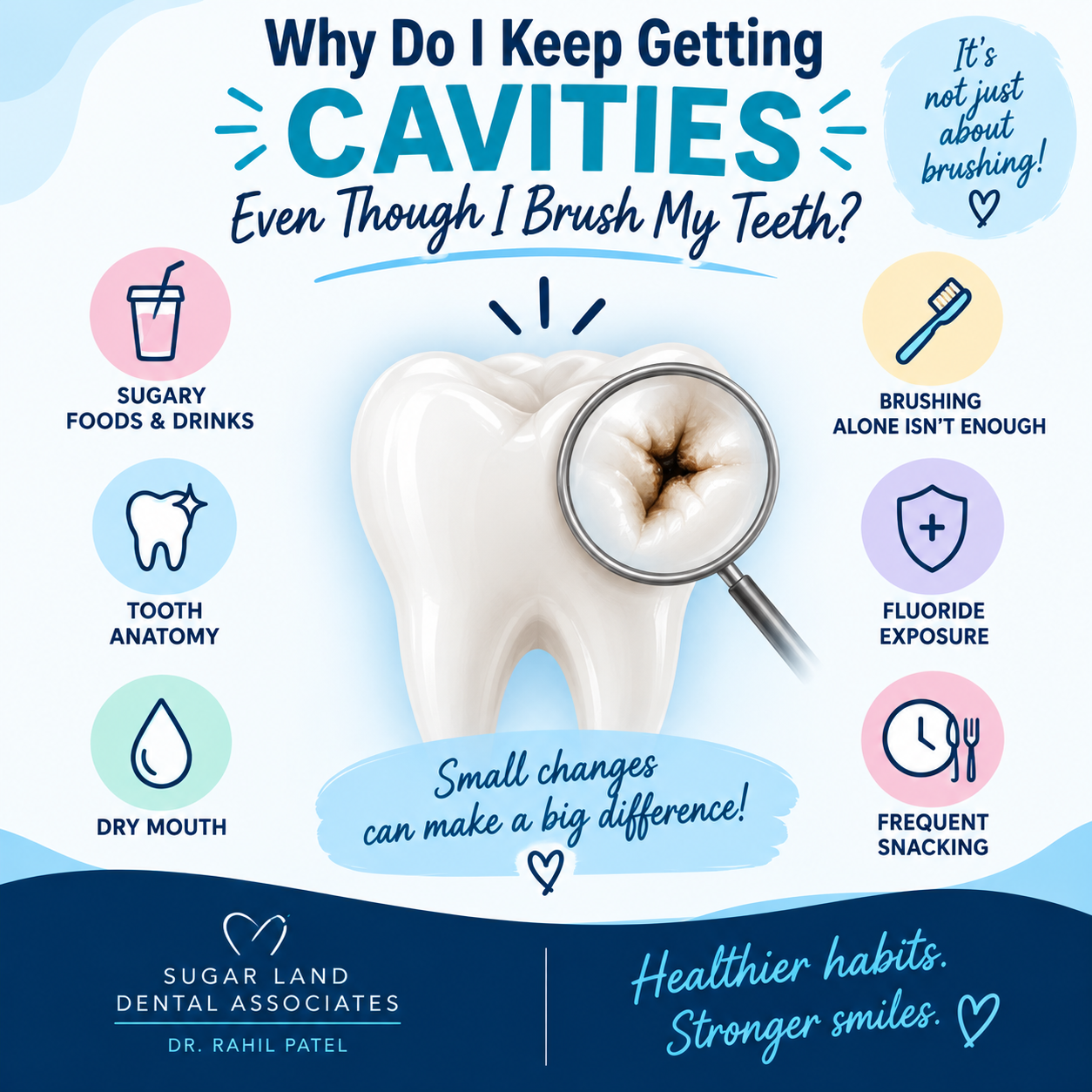
You brush twice a day, use toothpaste, and try to take care of your smile – so why does your dentist keep finding cavities? It is easy to assume that cavities only happen when someone does not 🤔 brush enough, but cavity risk is more complicated than that.
Brushing is extremely important, but it is only one part of preventing tooth decay. Cavities develop when bacteria in dental plaque use fermentable carbohydrates and produce acids. Repeated acid exposure can gradually remove minerals from enamel. Your diet, saliva, fluoride exposure, tooth anatomy, and cleaning between the teeth all influence that process.
1. You May Be Missing the Areas Between Your Teeth 🧵
A toothbrush cleans many surfaces well, but the bristles do not predictably clean the tight contacts between teeth. Plaque and food can remain in these areas.
That is why floss or another appropriate interdental cleaner is an important addition to brushing. Cavities between teeth may also be difficult to see without dental X-rays.
2. How Often You Snack Matters 🍬
Cavity risk is not only about the total amount of sugar you eat. Frequency matters too. Each time cavity-causing bacteria are exposed to fermentable carbohydrates, acids are produced.
Constant sipping or snacking can create repeated acid challenges throughout the day. Giving your mouth breaks between meals and snacks allows saliva time to help neutralize acids.
3. Sugary and Acidic Drinks Can Add Up 🥤
Soda, sweet tea, energy drinks, sports drinks, juice, and sweetened coffee can expose teeth to sugar, acid, or both. Slowly sipping these beverages over a long period can increase the amount of time your teeth are exposed.
Water is a tooth-friendly everyday beverage, and fluoridated water where available can provide an additional preventive benefit.
4. Dry Mouth Can Increase Cavity Risk 💧
Saliva helps wash away food particles, neutralize acids, and support remineralization. When saliva flow is reduced, the mouth loses some of these natural protective effects.
Dry mouth can have many causes, including medications and medical conditions. If your mouth frequently feels dry, mention it to your dentist.
5. Some Teeth Have Deep Grooves 🦷
Back teeth naturally have pits and grooves on their chewing surfaces. In some people these grooves are particularly deep and can trap plaque.
Good brushing remains important, but anatomy can make certain surfaces more cavity-prone. Depending on age, risk, and the tooth, preventive measures such as sealants may sometimes be considered.
6. Technique and Toothpaste Matter 🪥
Brushing twice a day does not automatically mean every surface is being cleaned effectively. Rushing, missing the gumline, using a worn toothbrush, or consistently skipping certain areas can leave plaque behind.
Fluoride toothpaste is an important part of cavity prevention because fluoride helps strengthen enamel and supports remineralization.
7. Everyone Has a Different Cavity Risk
Some people develop cavities more easily than others because of differences in saliva, diet, oral bacteria, tooth anatomy, previous dental history, and other factors. A history of recent cavities is itself useful information when planning prevention.
This is why prevention should be personalized rather than assuming that the same routine is enough for every patient.
What Can You Do Differently?
Start with the basics: brush twice daily with fluoride toothpaste, clean between the teeth every day, and pay attention to how frequently you snack or sip sugary drinks. If dry mouth is an issue, discuss it with your dentist rather than ignoring it.
At Sugar Land Dental Associates, Dr. Rahil Patel can look at where cavities are developing and help identify patterns. For one patient, the issue may be frequent sweet drinks; for another, it may be dry mouth, difficult-to-clean contacts, or deep grooves.
Getting another cavity does not automatically mean you have failed at oral hygiene. It is a reason 💙 to look more closely at your individual risk factors and adjust your prevention plan.
From Dr. Rahil Patel
“When a patient tells me, ‘But I brush every day,’ I believe them. The next question is what other factors may be increasing their cavity risk. Prevention works best when we look at the whole picture.”
Myth vs. Fact
❌ Myth: If I brush twice a day, I should never get a cavity.
✅ Fact: Brushing is essential, but cavities are influenced by many factors, including cleaning between teeth, diet frequency, saliva, fluoride exposure, tooth anatomy, and individual risk.
Quick Takeaways
• Brushing is only one part of cavity prevention. 🪥
• Clean between your teeth daily. 🧵
• Frequent sipping and snacking can increase acid exposure. 🥤
• Dry mouth can raise cavity risk. 💧
• Fluoride and a personalized prevention plan can help protect enamel.
FAQ
Q: Why do I get cavities even though I brush twice a day?
A: Brushing is important, but cavity risk also depends on interdental cleaning, diet frequency, saliva, fluoride exposure, tooth anatomy, and other individual factors.
Q: Does flossing help prevent cavities?
A: Cleaning between the teeth helps remove plaque from areas a toothbrush may not reach effectively and is an important part of cavity prevention.
Q: Can dry mouth cause more cavities?
A: Reduced saliva can increase cavity risk because saliva helps neutralize acids, clear food debris, and support remineralization.
Q: Is sugar the only food that causes cavities?
A: Cavity-causing bacteria can use fermentable carbohydrates, not just obvious sweets. How often teeth are exposed to these carbohydrates also matters.
Worried about cavities? Don’t Wait!
If you keep getting cavities despite brushing every day, do not simply brush harder. Call 281-207-4161 to schedule an examination with Dr. Rahil Patel at Sugar Land Dental Associates so we can look for the patterns and risk factors behind your cavities and build a prevention plan that fits you. 🦷💙