
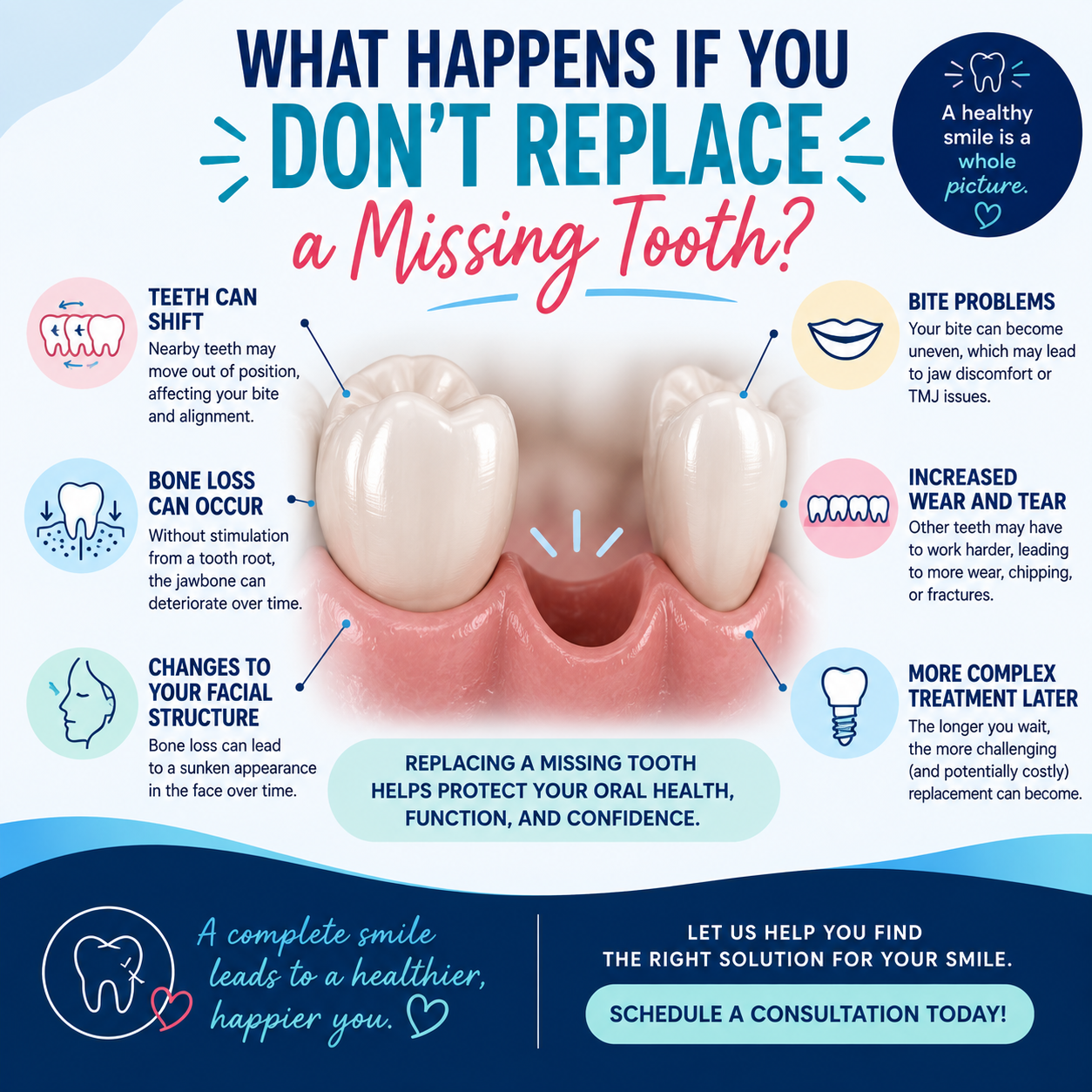
Losing a tooth can be stressful, especially when the space is not visible or causing pain. You may 😬 wonder, “Do I really need to replace one missing tooth?” The answer depends on your individual situation, but a missing tooth can affect much more than the appearance of your smile.
Your teeth, gums, jawbone, and bite work together as a system. When a tooth is lost, changes can gradually occur around the open space. Some happen slowly enough that you may not notice them right away. Understanding those changes can help you make an informed decision about whether and how to replace the tooth.
1. Neighboring Teeth May Shift 🦷
Teeth next to an open space can gradually tilt or drift toward it. The tooth above or below the space may also move because it no longer has the same contact during biting.
These changes can affect alignment and create new areas where food collects or where brushing and flossing become more difficult.
2. Bone Can Shrink in the Area 🦴
Natural tooth roots transfer forces to the surrounding jawbone. After a tooth is lost, the bone in that area no longer receives the same stimulation and can gradually resorb. The amount varies from person to person.
This can matter if you consider a dental implant later because available bone is one factor in implant planning. In some situations, additional treatment may be needed when significant bone loss has occurred.
3. Chewing May Become Less Efficient 🍎
Depending on which tooth is missing, you may begin favoring the opposite side of your mouth or avoiding certain foods. Over time, this can change how chewing forces are distributed across the remaining teeth.
4. Your Bite Can Change 😬
As surrounding teeth move, the way your upper and lower teeth meet can change. This may contribute to uneven contacts, food trapping, or different patterns of wear.
5. Cleaning Can Become More Difficult 🪥
An open space can collect food, and tilted neighboring teeth can create harder-to-clean areas. Good home care and regular dental examinations remain especially important after tooth loss.
6. Your Remaining Teeth May Carry Different Forces
The other teeth continue doing the work of chewing. Depending on the missing tooth and your bite, forces may be redistributed to the remaining teeth. Protecting those teeth is an important part of long-term treatment planning.
7. Your Smile May Change 😊
A missing front tooth obviously affects appearance, but even a less-visible missing tooth can eventually influence the position of neighboring teeth. Replacing a tooth can address both the space and its effect on function.
Does Every Missing Tooth Need to Be Replaced?
Not necessarily. The location of the missing tooth, condition of neighboring teeth, bite, gum health, bone levels, medical history, and your goals all matter.
Two common fixed options are dental implants and dental bridges. An implant replaces the missing root with an implant that supports a restoration and does not rely on neighboring teeth for support.
A bridge replaces the missing tooth using adjacent teeth for support. Each has advantages and limitations, and neither is automatically the right choice for everyone.
What If the Tooth Has Been Missing for Years? 📅
It may still be possible to replace it. Dr. Rahil Patel can evaluate the space, neighboring teeth, gums, bite, and available bone. Imaging may be recommended when appropriate to understand the anatomy and discuss realistic options.
At Sugar Land Dental Associates, the goal is not simply to fill an empty space. It is to consider how a replacement fits into the health, function, and appearance of your entire smile. If you have been 💙 living with a missing tooth because it does not hurt, an evaluation can help you understand what is happening and what options may be appropriate.
From Dr. Rahil Patel
“A missing tooth is about more than an empty space. I want patients to understand how tooth loss can affect the surrounding teeth, bone, bite, and function so they can make an informed decision about replacement.”
Myth vs. Fact
❌ Myth: If a missing tooth does not hurt, there is no reason to think about replacing it.
✅ Fact: A missing tooth may be painless while neighboring teeth, bone, and the bite gradually change.
Quick Takeaways
• Neighboring teeth can shift toward an open space. 🦷
• Bone in the area can gradually decrease after tooth loss. 🦴
• Chewing and bite relationships may change. 🍎
• Dental implants and bridges are two common fixed replacement options.
• Even a tooth that has been missing for years can still be evaluated. 📅
FAQ
Q: What happens if I don’t replace a missing tooth?
A: Depending on the situation, nearby teeth may shift, bone can resorb, and chewing or bite relationships may change over time.
Q: Can a missing tooth cause bone loss?
A: Yes. After a tooth is lost, the jawbone in that area can gradually resorb because it no longer receives the same stimulation from a natural tooth root.
Q: Is it too late to replace a tooth that has been missing for years?
A: Not necessarily. A dental evaluation can assess the space, neighboring teeth, gums, bite, and available bone.
Q: What are common ways to replace one missing tooth?
A: Dental implants and dental bridges are two common fixed options. The appropriate choice depends on your individual oral health and treatment goals.
Ready to Replace a Missing Tooth?
Have you been putting off replacing a missing tooth because it does not hurt? Call 281-207-4161 to schedule an evaluation with Dr. Rahil Patel at Sugar Land Dental Associates to understand what is happening in the area and discuss which options may fit your smile and long-term oral health. 🦷💙